Tuesday, September 29, 2015

The Golden Rule Triangle

Line segments in the golden ratio
A golden rectangle (in pink) with longer side a and shorter side b, when placed adjacent to a square with sides of length a, will produce a similar golden rectangle with longer side a + b and shorter side a. This illustrates the relationship  \frac{a+b}{a} = \frac{a}{b} \equiv \varphi.
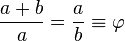
In mathematics, two quantities are in the golden ratio if their ratio is the same as the ratio of their sum to the larger of the two quantities. The figure on the right illustrates the geometric relationship. Expressed algebraically, for quantities a and b with a > b > 0,
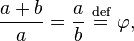
 \frac{a+b}{a} = \frac{a}{b} \ \stackrel{\text{def}}{=}\ \varphi,
where the Greek letter phi (\varphi or \phi) represents the golden ratio. Its value is:
\varphi = \frac{1+\sqrt{5}}{2} = 1.6180339887\ldots. OEISA001622
The golden ratio also is called the golden mean or golden section (Latin: sectio aurea).[1][2][3] Other names include extreme and mean ratio,[4] medial section, divine proportion, divine section (Latin: sectio divina), golden proportion, golden cut,[5] and golden number.[6][7][8]

Some twentieth-century artists and architects, including Le Corbusier and Dalí, have proportioned their works to approximate the golden ratio—especially in the form of the golden rectangle, in which the ratio of the longer side to the shorter is the golden ratio—believing this proportion to be
//

Saturday, September 7, 2013

The number e mathematical constant is the base of the natural logarithm.

Euler's number e


The number e is an important mathematical constant that is the base of the natural logarithm. It is approximately equal to 2.71828,[and is the limit of (1 + 1/n)n as n approaches infinity, an expression that arises in the study of compound interest. It can also be calculated as the sum of the infinite series[2]
e = 1 + \frac{1}{1} + \frac{1}{1\cdot 2} + \frac{1}{1\cdot 2\cdot 3} + \frac{1}{1\cdot 2\cdot 3\cdot 4}+\cdots

The constant can be defined in many ways; for example, e is the unique real number such that the value of the derivative (slope of the tangent line) of the function f(x) = ex at the point x = 0 is equal to 1.[3] The function ex so defined is called the exponential function, and its inverse is the natural logarithm, or logarithm to base e. The natural logarithm of a positive number k can also be defined directly as the area under the curve y = 1/x between x = 1 and x = k, in which case, e is the number whose natural logarithm is 1. There are also more alternative characterizations.

Alternative characterizations


The area between the x-axis and the graph y = 1/x, between x = 1 and x = e is 1.
Other characterizations of e are also possible: one is as the limit of a sequence, another is as the sum of an infinite series, and still others rely on integral calculus. So far, the following two (equivalent) properties have been introduced:
1. The number e is the unique positive real number such that
\frac{d}{dt}e^t = e^t.
2. The number e is the unique positive real number such that
\frac{d}{dt} \log_e t = \frac{1}{t}.
The following three characterizations can be proven equivalent:
3. The number e is the limit
e = \lim_{n\to\infty} \left( 1 + \frac{1}{n} \right)^n
Similarly:
e = \lim_{x\to 0} \left( 1 + x \right)^{\frac{1}{x}}
4. The number e is the sum of the infinite series
e = \sum_{n = 0}^\infty \frac{1}{n!} = \frac{1}{0!} + \frac{1}{1!} + \frac{1}{2!} + \frac{1}{3!} + \frac{1}{4!} + \cdots
where n! is the factorial of n.

5. The number e is the unique positive real number such that
\int_1^e \frac{1}{t} \, dt = 1.

Monday, September 2, 2013

research in graph theory prove that all maps could be colored using only four colors


Much research in graph theory was motivated by attempts to prove that all maps, like this one, could be colored using only four colors so that no areas of the same color touched. Kenneth Appel and Wolfgang Haken proved this in 1976.[5]